Monthly Archives: October 2008

Preparing your kitchen before you leave for vacation

Photo by betsyjean79

In the mad dash to finish packing, make sure nothing is forgotten, and get out the door, it can be easy to overlook some important aspects of travel preparation, including thorough cleaning of your home.

I usually try to thoroughly clean every room before I leave, not only because it’s nice to come back to a clean house after vacation, but also because it allows me to ensure that I haven’t forgotten anything.

If you’re short on time, the one room you should never overlook is the kitchen. Here’s a short list of how I prepare my kitchen before I leave.

1. Plan ahead to avoid leaving a fully stocked freezer behind.

Because I stockpile meat, it’s not uncommon for me to have $40 or $50 worth of food in the freezer at any given time. I don’t like leaving this kind of investment behind when I’m leaving town. If the power went out while we were away, not only would we lose all that meat, but we’d come home to a stinky, unsanitary mess.

To avoid the unthinkable, I spend the weeks leading up to a vacation clearing out my meat stockpile. I stop buying bulk meat for a month or so before vacation, and start using it up in meals. Since we rarely leave town, this is relatively easy for us to do.

2. Clean out the refrigerator before you go.

Try to use as much of your food as possible to avoid waste, and leave your refrigerator free of perishable foods. We usually remove all leftovers and anything that will expire before we return. You don’t want to come home to a smelly refrigerator.

Condiments with a long shelf life like ketchup and mustard are fine to leave. Items like milk, cheese, and eggs should probably go depending on how long you’ll be gone. A power outage may be unlikely, but do you really want to risk having to clean up that kind of mess? Spoiled dairy can leave your refrigerator smelly forever.

3. Don’t leave unsealed food on the counters, in the pantry, or in the sink.

This is particularly important in the warm summer months. When we’re leaving town, we typically shut off the AC so we’re not paying to cool an empty apartment. If you’re going to do this, it’s essential that you completely clear your kitchen of any unsealed food items or fruit to avoid bugs.

Make sure items like sugar are sealed up in airtight containers. If you have open containers of crackers, cookies, bread, or other foods, you should eat them, take them with you, or throw them away before you leave. If it’s sealed airtight, it should be safe. Otherwise, don’t leave it in your kitchen.

Make sure all garbage cans and recycling bins are empty and clean. I also run my garbage disposal one last time and pour some bleach or other cleaning solution down it before I leave. I learned this lesson the hard way in college when I returned home after a weekend away to find a rotten piece of watermelon in the garbage disposal and a kitchen full of fruit flies. We didn’t get rid of them until fall when the weather cooled down. It was a nightmare.

4. Make sure all dishes are clean, dry, and put away.

Dirty dishes, standing water and warm temperatures can lead to mold and bacteria. Not to mention, nobody likes to come home to a sink full of dishes to put away or, worse, wash. I always do one last load of dishes the night before I leave, dry them, and put them away. I wash any last-minute dinner or breakfast dishes by hand, dry and put those away, too. Don’t leave any dishes, dirty or clean, in your dishwasher.

5. Unplug everything but the refrigerator and the oven.

Appliances like toaster ovens, blenders, and stand mixers are not only fire hazards when left plugged in unattended, they also drain extra energy. If you unplug everything before you go, your kitchen will be safer while you’re gone and you’ll be pleasantly surprised by a lower electric bill upon your return.

How to avoid high luggage fees at the airport

Photo by geishaboy500

It’s bad enough that airline tickets have skyrocketed in the past two years, but recent hikes in luggage checking fees have made travel even more expensive. Some airlines, including American, Northwest, United, and US Airways, are even charging for your first checked bag.

Here are some tips for avoiding these excessive fees, or at least reducing their impact on your travel budget.

1. Be familiar with the airline’s policies before you buy your tickets.

Online ticket brokers like Expedia.com and Priceline.com have made it easy to compare major airlines’ prices before purchasing tickets. (Keep in mind, they also charge fees for their services, so I recommend purchasing your tickets directly through the airline.)

Unfortunately, when buying through these sites, it’s easy to forget extra add-on fees in your quest for the cheapest price. You may purchase a ticket from United because it’s $15 cheaper than Delta, but you’ll end up paying the same after you check your bag.

This handy chart from Travel Insider compares all of the checked luggage policies of major airlines as of July 2008. Be familiar with these policies, and bear in mind the length of your trip, how many bags you’ll have to check per passenger, and the likely weight of each bag. Figure all of this information into the final ticket price so you’ll have a better comparison when purchasing.

2. Avoid checking luggage all together by carrying on if possible.

According to this carry-on luggage policy chart, all of the major airlines still allow a free carry-on bag and “personal item” for each passenger. Personal items include purses, laptop cases, backpacks, etc. It should be easy to fit all of your necessities in a carry-on and personal bag if your trip is short. Take advantage of this, especially if your airline charges for your first checked bag.

The airline we’re traveling on doesn’t charge for the first checked bag, but we prefer carrying on anyway to eliminate the risk losing our luggage during a layover. Luckily for us, our trip is short. We’ll only be staying for three days. So all of our luggage will be with us for the duration of the trip.

3. Minimize your toiletries, especially for carry-on bags.

Staying in a hotel? Then you probably don’t need to worry about toiletry items like shampoo, conditioner, soap, and mouthwash. Most hotels will provide these for you. This is good news if you’re carrying on since current Transportation Security Administration restrictions limit liquids in carry-on bag.

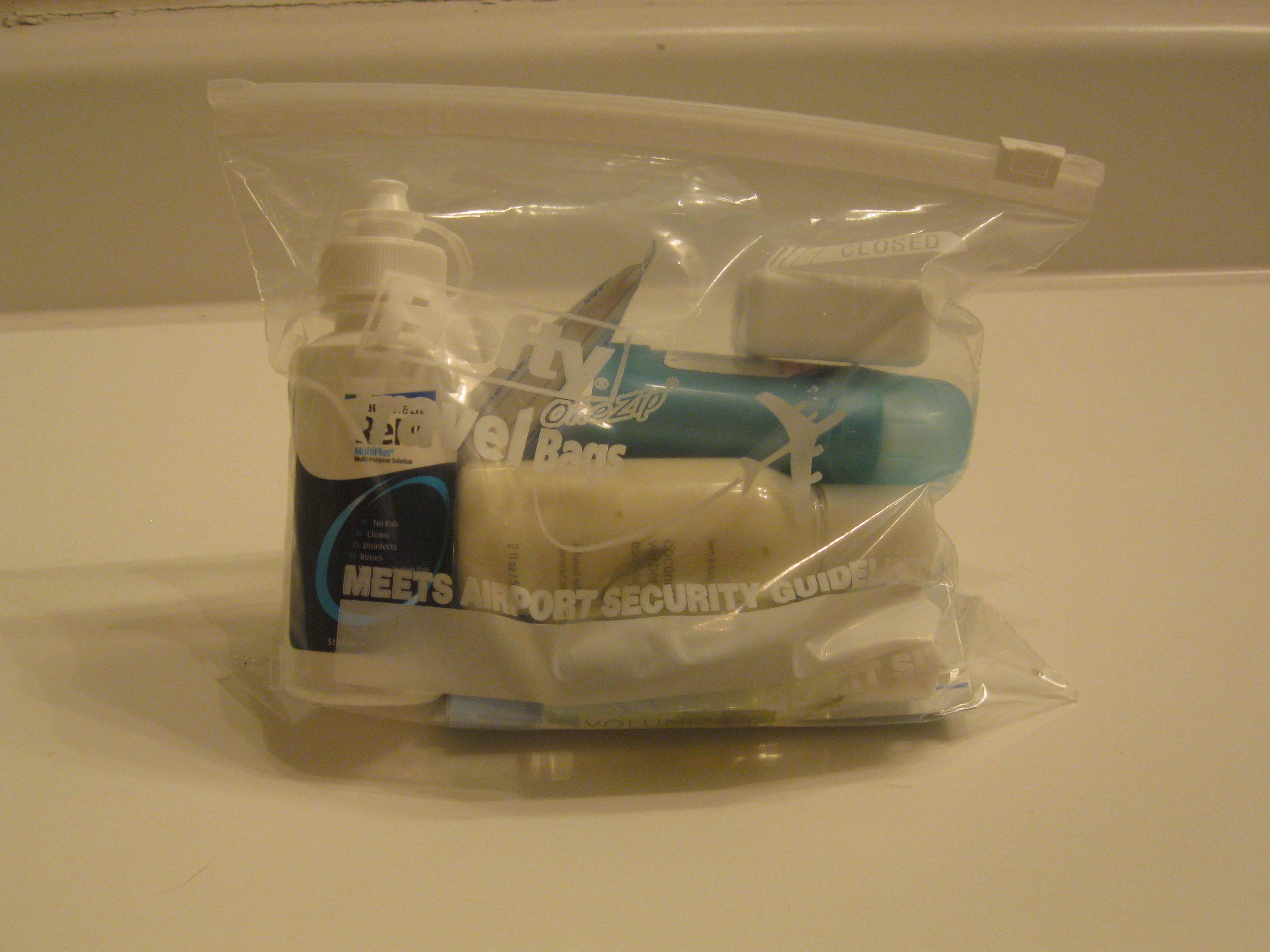
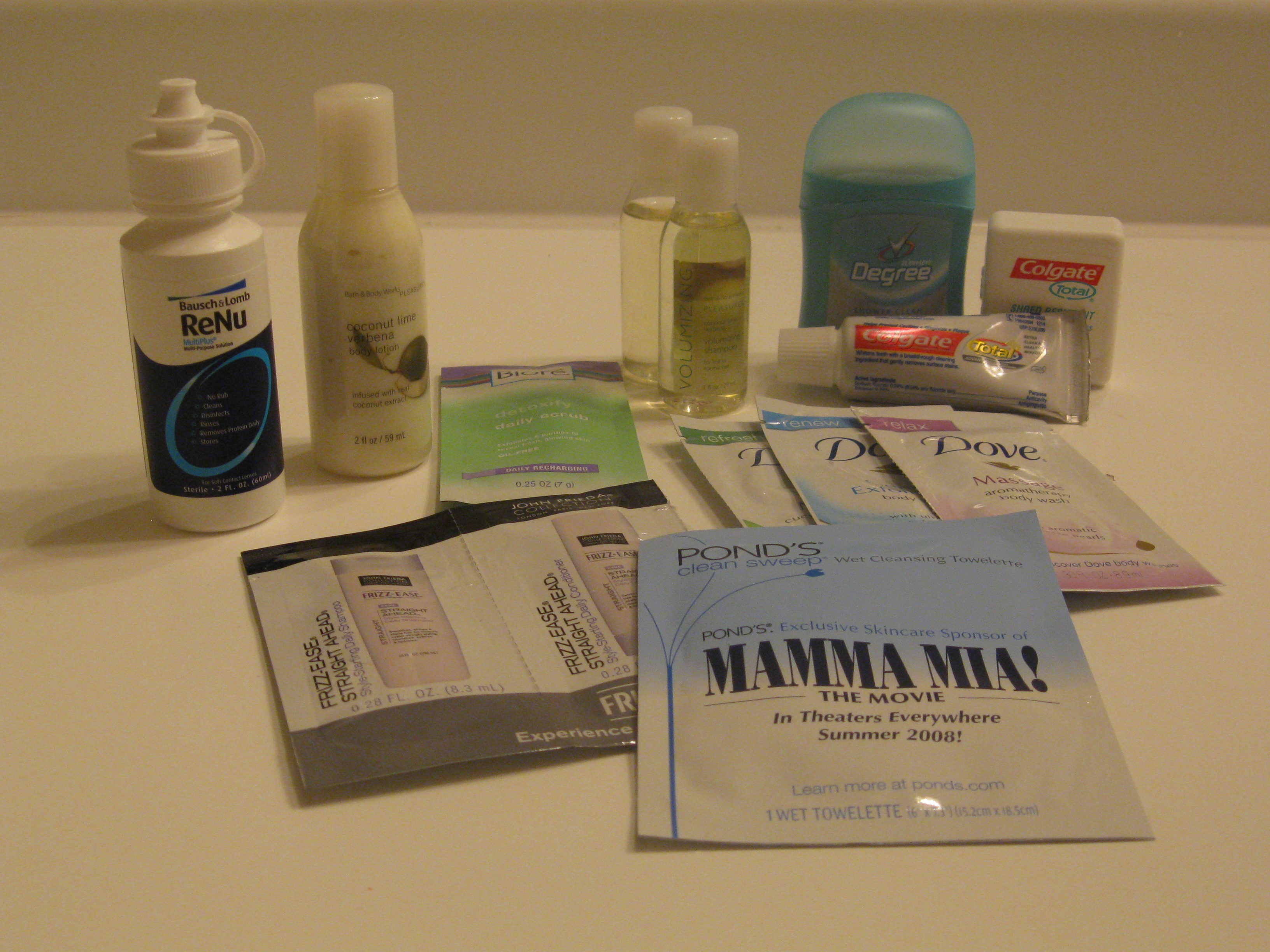
We’re staying with my sister, so we’re bringing our own toiletries. No problem for frugal folks like us. We’ve been collecting free samples for months. We also have some leftover hotel toiletries from our honeymoon. Samples easily meet the 3 oz. or less requirement for carry-ons, and they’re compact enough to fit into the TSA-approved quart-sized zipper bag. Plus, it’s fun to try some new toiletries on vacation.

Here’s three day’s worth of mini toiletries:

And look how nicely they fit in a 1-quart bag:

4. If you must check luggage, weigh your bags before you leave.

The surcharges for extra weight can cost a fortune. You can refer to this chart again for luggage weight limits and costs. Save yourself some trouble, and money, by putting your suitcase on a scale before you leave for the airport. Move some items to your checked luggage or to a backpack that you can carry on as a personal item if your bag weighs too much. If you can’t get around the extra weight, at least you’ll be prepared for the high fees when you check your bag.

5. Pack light!

This one is last on the list because, well, duh. The best way to save money on checked luggage fees is not to check luggage, even for longer trips.

If you’re very careful about how and what you pack, you should be able to get a week’s worth of necessities into a carry-on suitcase and personal bag. Notice, I said necessities. Obviously you can’t scrimp space on items like underwear and socks, but everything else is up for negotiation. Do you really need more than one pair of shoes? What about that extra sweater?

For long trips, most hotels offer coin laundries as a courtesy to guests. Doing laundry might not seem lik a fun vacation activity, but it’s certainly a lot cheaper than paying $15-$25 per checked bag. That money could go to something a lot more worthwhile on your trip, like a nice restaurant meal or a museum admission. Take that into consideration when deciding whether it’s really worth it to check your bag.

Ahhh … vacation!

We’re on our way to airport right now after a mad dash of last-minute packing, rushing out the door, and dropping the dog off at the kennel. We should arrive in Seattle this afternoon.

I’m looking forward to some much needed quality time with my sister, brother-in-law, my adorable niece and nephew, and my parents. I haven’t seen my sister and her family in 16 months, and I haven’t seen my parents since the wedding in May.

In my absence, I’ve scheduled some appropriate posts related to travel, particularly some of our experiences in planning this trip. I hope you enjoy them!

I’ll be back Tuesday. Enjoy the weekend!

Overloaded with free samples or drugstore deals? Donate them for a good cause!

I just came across a great idea for donating unused drugstore deals or free samples, and I wanted to pass it along.

I know a lot of frugal folks collect tons of free samples or stockpile toiletries with the drugstore deals. Lately, I’ve been reading posts from a lot of you about how your stashes have gotten out of control. If you fall into this category and you’ve collected way more free samples or drugstore deals than you can reasonably use, consider donating them to a homeless or domestic violence shelter.

I stumbled across this MySpace page that shares the idea, and I think it’s a great concept.

This website from the US Department of Housing and Urban Development offers resources about homeless shelters in your area. Find one near you, and see if they participate in a program like this.

You can also contact local domestic violence shelters to see if they’re interested in donations.

If you find a participating organization, not only will you be donating to a good cause, but you’ll clear some clutter from your home. It’s win-win!

Has anybody had any success with this? Please let me know!

Subscribe

September Budget Round up

The good news is we were on budget in most of our spending categories in September. The bad news is we were $42 over in our miscellaneous “shopping” category. Part of the problem was five shirts I bought on clearance for $21 a couple weeks ago. I also forgot to budget for the $25 I spent on Tony’s birthday present. Oops.

We also went $30 over our food budget. As I look through our spending, I’m seeing red flags like Starbucks and ice cream shops. Looks like we stopped for a coffee, ice cream, or other snacks while running weekend errands several times throughout the month. Those little purchases added up to a $30 overage in our food budget. Good thing I’m getting my diet back on track now. It’ll be good for my waistline and my wallet!

Setbacks: Overspending in food and shopping. These are our two biggest discretionary spending categories, and also the ones we need to watch closest to avoid overspending. It also looks like this months’ budget included five trips to the grocery store instead of four. (The last shopping trip of the month in August and the last shopping trip in September were both included in September.) I’m not sure how to account for this in future budgets. What do you do when that happens?

Successes: We’ve been putting money aside for our dog’s yearly vet bills and flea and tick prevention medicines. Last week, Howie was due for his yearly physical, vaccinations, and city license. The $100 bill didn’t throw off our budget at all, because we had $75 saved and $50 budgeted toward pet expenses for the month. So we ended up being $14 under in pet spending instead of $60 over. Yay for planning ahead for necessary expenses!

This is also the second month that we immediately moved a little over 10% of our income into savings. I used to try to move what was left at the end of the month into savings. Bad idea. As you can imagine, there was usually not much left. I love getting it out of the way in the beginning of the month. It removes the temptation to spend what we should be saving.

Snowflakes: $50 refund from Costco membership (my employer pays provides membership as a perk, so I was able to cancel our current membership and get a refund). $60 printer cartridge refund from 123InkJets.

October Goals: Remember to account for everything in the budget, especially purchases outside our regular monthly expenses, like Tony’s birthday gift. Avoid letting little purchases add up to a big overage in the budget. Check up on spending in food and “shopping” every week to make sure we’re on track.

Bottom line: +$14 (from pet spending category) – $72 (overage in shopping and food) = -$58 for the month of September. Not counting snowflakes and the money we put into savings, we spent $58 more than our income this month. Not good. I’m reminding myself that this is new, and it’s going to take us some time to get used to sticking to the budget. Next month is an opportunity to do better and learn from this month’s mistakes.

Hope you were more successful that we were in your budgeting for September!

Get a great price on wedding bands online without getting ripped off

My husband and I agreed that we didn’t want to spend a fortune on wedding bands. I know, it seems counter-productive to spend less on something you’ll keep forever. I’m just not into jewelry, though. Anything flashy (read: expensive) would have looked out of place on my hand. The same is true for my husband. We opted for plain, white gold bands.

We were disappointed by the prices in brick and mortar stores even for plain gold bands. The prices online were much more reasonable, but buying jewelry online just seemed so risky.

After much deliberation and research, we ended up buying our rings online. We paid about half the price we would have paid in the store, and they engraved them for free. Here’s the process we went though to make sure we were getting the right rings from a reputable dealer at a good price.

Shop in a brick and mortar store first to find the right style.

Jewelry is a lot like eyeglasses; you never know what’s going to suit you until you try it on. I originally wanted a much thinner band than I ended up buying. After trying one on in the store, I realized the thin band looked weird on my hand. That’s why it’s important to shop in a brick and mortar store, try on a lot of different rings, and find the style you like best.

Have your ring finger professionally sized.

Many women already know their ring size. Most men don’t. If you’re unsure about either of your sizes,  just ask a jeweler to size your finger while you’re shopping in a brick and mortar store. Some online stores offer free resizing, but you’ll still have to go through the hassle of sending back the ring and waiting.

If possible, have your finger sized on a hot, humid day. Your fingers swell in the heat and humidity and shrink in the cold. Sizing your finger on a humid day will ensure a comfortable fit year round.

Compare prices and special offers at several online wedding band retailers.

We had a lot of different options since we wanted plain bands; everybody carries plain bands. Most of the prices we saw were comparable. However, the site we chose, iweddingband.com, offered slightly lower prices, free shipping, and free engraving.

Make sure you’re buying from a reputable online jeweler.

There are several things you can do to check up on an online seller. First, look for a Better Business Bureau online seal. Clicking on the seal should take you to a unique verification page specific to that site at the Better Business Bureau website. Here’s what it looks like:

Beware of sites where the logo is a dead link. As you can see, it’s easy to copy and paste the BBB logo. The logo must be linked to a unique verification page in order to be legit. Most reputable sites also link to secure transaction sites like VeriSign, GeoTrust, or Authorize.net to ensure that your credit card information will be secure. Be sure to click on these logos to verify their legitimacy, too.

4. Find out what other customers are saying.

Just because a jeweler is legit doesn’t mean they offer good customer service. I researched potential sellers exhaustively for customer reviews.

Many online businesses list their products on Amazon. This is a good place to find credible reviews for online sellers. You can see the Amazon profile for iweddingband.com here. I’d say 100% positive reviews in the past 30 days is a pretty safe bet to me. The comments say things like, “Fast shipping, great product,” etc. Seeing all of those happy customer reviews made me feel pretty secure.

We ended up paying a total of $150 for both of our 14K white gold wedding bands including shipping and engraving. They are also the “comfort fit” bands that are designed for a better fit without cutting into your finger.

Here’s a list of some of the other sites I considered. Don’t take my word for it, though. Be sure to do your own comparison shopping and research on the companies before buying so you can feel secure in your purchase.

E-Wedding Bands – Offers free shipping and free sizing. 30-day return policy.
Blue Nile – Huge selection of wedding bands and diamond engagement rings. Free shipping and 30-day return policy.
James Allen – Loose diamonds, engagement rings, and wedding bands. Free insured shipping. Free sizing up to 60 days.

Clean out the refrigerator before you put away your groceries

Have you ever found leftovers shoved in the back of the refrigerator and forgotten for weeks? Um, me neither. OK, so I have. But not for a very long time, because we have a simple system for clearing out the old stuff these days.

Every week before we go to the grocery store, we clean out the refrigerator. We check all expiration dates, get rid of uneaten leftovers from the week before, and make room for the new groceries.

Not only does this ensure the removal of dated food, it also eases the process of putting groceries away when we return from the grocery store. Because we’ve already shifted and organized everything, it’s easy to fit all of the week’s groceries. It’s also a good opportunity to take stock of your freezer and condiment inventory and make additions to the grocery list if necessary.

Putting away groceries is a lot less stressful when we’re not trying to make space in the refrigerator at the same time.

Looking for more kitchen organization ideas? Check out this week’s Works for Me Wednesday carnival at Rocks in my Dryer.